Archive for the Offense Category

Declining Options: Potential Hitting Fits for Baltimore

Posted in Offense, Offseason with tags , , , , , on November 10, 2013 by oriolesprovingground

The offseason is a week old, and one of the very first orders of business for teams (or players) is to do decide whether or not they should pick up their contract options or cut bait and become free agents.  On Friday we took a look at the pitchers, so today we’ll look at some bats.  If I state that I think the team should make an offer, it doesn’t mean that they should do whatever it takes to sign them.  Due to the larger number of players, I’ll try to keep the explanations brief.

Infielders

Alexi Casilla ($3 million team option declined by Orioles)

As expected, Casilla did nothing with the bat in 2013, but made up for the lack of being able to hit a baseball by doing a good job of fielding it at 2B, and was essentially the definition of a replacement player.

Verdict: Make a minor league offer with an invite to spring training Continue reading

Making the Orioles a Champion in 2014

Posted in Offense, Offseason, Pitching with tags , on November 5, 2013 by oriolesprovingground

Over the past month, the writers at Camden Depot took on the task of analyzing the 2013 Baltimore Orioles on a position by position basis, which was followed with our own suggestions to make the 2014 better.  The following are links to each write up.

Starting Pitching (Nate Delong): Part 1 and Part 2

Right Handed Relievers (Stuart Wallace)

Left Handed Relievers (Stuart Wallace)

Catcher (Jon Shepherd)

First Base (Jon Shepherd)

Second Base (Joe Reisel): Part 1 and Part 2

Third Base (Stuart Wallace)

Shortstop (Nate Delong)

Left Field (Matt Kremnitzer)

Center Field (Matt Kremnitzer)

Right Field (Matt Kremnitzer)

Designated Hitter (Joe Reisel)

Bench (Joe Reisel)

Conclusion (Jon Shepherd)

Everyone did a great job on these posts and there is a lot of good information here, so I suggest you check it out.  Feel free to leave your own suggestions as to what the Orioles should do this offseason by commenting in the posts at Camden Depot (preferred) or here on this site.

Statistically Speaking: Wrapping up the 2013 Orioles

Posted in Offense, Offseason, Pitching with tags on October 12, 2013 by oriolesprovingground

Like most teams, the 2013 Baltimore Orioles came up short of the playoffs, and will have some decisions to make heading into the offseason.  The Orioles finished the season with an 85-77 record, tied for 3rd place in a predictably competitive AL East.  They were 12 games behind the Boston Red Sox and 6.5 games out of the second wild card spot.  They were in the thick of the wild card race up until a 6 game losing streak beginning on September 19 ultimately did them in.  As I mentioned last week, despite winning 8 fewer games than they did in 2012, they arguably had a better team this year than last year.  In large part, this was due to the fact that they went from having the best record in one run games in 2012 (29-9) to the worst record in one run games in 2013 (20-31).  Some of this is luck, but some of it is also due to a less effective bullpen in 2013, as you’ll see below.

After the jump, you’ll find several tables that look at how the 2013 Orioles performed in certain categories compared to the rest of the American League as well as all of baseball.  It will provide a starting point to look at what the Orioles need to do to improve for the 2014 season.  In addition to my offseason opinions on this site, the writers at Camden Depot (the ESPN affiliated blog for the Baltimore Orioles) will be doing a position by position analysis that looks at what happened in 2013, and the steps that the Orioles need to take to improve that position to win the World Series in 2014.  I am responsible for the starting pitchers and the shortstop position.  I plan on linking to my posts as they go up, and will also post links to all the position write-ups at the end of the month when we’re all finished.

As always, please consult the Fangraphs Library for definitions of advanced statistics such as wOBA, FIP, UZR/150, and DRS.

Continue reading

Eulogizing the 2013 Orioles

Posted in Defense, Offense, Pitching with tags , on October 1, 2013 by oriolesprovingground

Friends and fans, we are gathered here today to remember the extremely promising, but ultimately unfulfilling life of the 2013 Baltimore Orioles, as their season officially came to an end.  Building on the playoff appearance last year that many analysts called “lucky”, the Orioles made a valiant effort to return to the playoffs, only to fall out of contention (mathematically) with 5 games remaining, due to an ill-timed losing streak at the hands of the Tampa Bay Rays.

Continue reading

Do the Orioles Hitters Have a Home Run Problem?

Posted in Offense with tags , , , on September 24, 2013 by oriolesprovingground

The Orioles offense has struggled mightily in the month of September, and recently there has been talk that one of the problems with their offense is that it relies too much on the home run.  Today, I have a post over on the ESPN Sweetspot Network Orioles blog, Camden Depot that takes a look at whether the Orioles hit too many home runs, which when you read it out loud, sounds pretty absurd.

Direct Link to Article –> Do the Orioles Hitters Have a Home Run Problem?

Minor League Recap: August 26-Spetember 2

Posted in Minor Leagues, Offense, Pitching, Prospects with tags , , , , , , , , , , , , on September 5, 2013 by oriolesprovingground

Welcome to the second and final installment of the Minor League Recap for the 2013 season, coming to you a day later than normal to include the final game, which was played on September 2.  None of these teams advanced to their respective league’s playoffs, so their seasons are no over.  Maybe next week I’ll attempt to do a full season minor league recap for Norfolk, Bowie, and Frederick, but then again, maybe I won’t.  As always, the following is based on performance only, and is not to be considered a list of prospects.

Weekly Summary

Norfolk (AAA): 6-3 (W-L), 34 RS, 27 RA

Bowie (AA): 4-5, 51 RS, 33 RA

Frederick (High-A): 4-5, 40 RS, 52 RA Continue reading

A Quick Hit on the Mike Morse Trade

Posted in Offense, Prospects, Trades with tags , , , , on September 4, 2013 by oriolesprovingground

After reportedly claiming every available batter that was put on revocable waivers during the month of August, the Orioles finally were able to acquire one of them, by trading minor league outfielder Xavier Avery to the Seattle Mariners for DH/LF Mike Morse.  In theory, the Orioles receive a much needed upgrade at the DH position for the price of a speedy/athletic outfield quasi-prospect who has never really hit much at any level of the minor leagues.

Morse is viewed as a slugging DH/outfielder and was considered one of the Mariners big acquisitions during the off-season in an attempt to add power to their lineup.  Continue reading

Minor League Recap: August 19-25

Posted in Minor Leagues, Offense, Pitching, Prospects with tags , , , , , , , , , , , , on August 27, 2013 by oriolesprovingground

Recently, as I was thinking of potential topics to write about, it occurred to me that Orioles Proving Ground has not dealt much with the minor league system of the Baltimore Orioles.  This is somewhat strange considering that the name of the blog was partially meant to invoke images of players in the minors proving their worth and graduating to the major leagues.  That has not really happened to date, other than maybe a couple of posts.  In order to change this, I thought we would start a weekly feature that looks at the best and worst individual performances of Baltimore’s top three minor league affiliates (AAA, AA, and Hi-A).  Conveniently, the minor league season will be coming to a close in the next week, so there will only be two installments of this series in 2013, after which it will hopefully pick up again during the 2014 season.  For the most part this is just a recap, but some analysis may be given where appropriate.

Just a note.  As I do not have much scouting experience and have not attended many minor league games this summer, these posts will look at on field performance only and are not meant to be used as scouting reports.

Continue reading

Who is the Most Clutch Oriole?

Posted in Offense with tags , , , , , , , on August 23, 2013 by oriolesprovingground

The following post was written by Doug Nickerson as a guest post for Orioles Proving Ground.  Nickerson grew up as a Red Sox fan on Cape Cod, MA and is looking forward to writing about the Orioles with his knowledge of the AL East from a non-emotional perspective.  He moved to the DC area last August, and while he loves the city, he hates humidity and traffic.

In watching so many games this year with the purpose of evaluating the players instead of solely enjoying the beauty of the game, many ideas have percolated from the frustrations of watching teams struggle to score, while others seem to score with ease.  Now obviously some matchups are lopsided causing teams to either easily run up the score or look helpless at the dish.  But the real question I ask myself is, what is the relationship between being good and being able to perform under pressure?

On the surface, the Orioles haven’t been able to turn it on when it counts this year compared to last year, especially when considering their record in 1 run games has gone from 29-9 in 2012 to 14-22 this year.  What’s the cause of this? Is it purely luck? Did last year’s team have nerves of steel compared to this year or is it just the law of averages taking its course?

To compare this year and last year, I needed to look at clutch stats.  The easiest to compare is baseball-reference.com’s “clutch” stat, which is based on its win probability stat and average leverage index.  The clutch stat normalizes these numbers so that a player with a clutch rating of 0 is an average player and a positive or negative rating is more or less clutch, respectively.  Let’s take a look at the offensive numbers (I included guys with at least 45 ABs for the season).

2013 Clutch Rating

2012 Clutch Rating

Chris Davis

1.7

Adam Jones

1

Chris Dickerson

1.1

Taylor Teagarden

0.7

Adam Jones

1.1

Nate McLouth

0.6

Nick Markakis

0.7

Jim Thome

0.6

Steve Pearce

0.7

Mark Reynolds

0.4

Brian Roberts

0.6

Steven Tolleson

0.4

Alexi Casilla

0.5

Chris Davis

0.2

Manny Machado

0.4

Manny Machado

0.2

Danny Valencia

0.4

Matt Wieters

0.1

Yamaico Navarro

0.1

Steve Pearce

0.1

Travis Ishikawa

0

Nolan Reimold

0.1

Taylor Teagarden

0

J.J. Hardy

0

Henry Urrutia

0

Nick Markakis

0

Chris Snyder

-0.1

Endy Chavez

0

Nolan Reimold

-0.2

Brian Roberts

0

Nate McLouth

-0.3

Ryan Flaherty

-0.1

Matt Wieters

-0.4

Ronny Paulino

-0.1

J.J. Hardy

-0.5

Xavier Avery

-0.2

Ryan Flaherty

-0.8

Nick Johnson

-0.2

Omar Quintanilla

-0.3

Lew Ford

-0.4

Robert Andino

-0.7

Wilson Betemit

-0.9

Now, as expected, Chris Davis is the most clutch player on the 2013 team and that’s a reason why he is rightfully in the MVP race.  The surprising results of this stat is that 3 regulars are considered the most clutch hitters on the team (Davis, Jones, Markakis) and 3 regulars are considered to wilt during the big moments (McLouth, Wieters, Hardy) for the 2013 season.  When compared to last year’s team, only 2 players that got regular starts (Andino and Betemit with over 350 ABs each) had a negative rating.  This could be a potential reason for the drastic change in their record in 1 run games.  However, now the question arises as to how much are they affected by the big situation?  How much does 0.1 clutch point reflect into a player’s OBP in high leverage situations? Is it substantial, where all hope is lost if there are two outs, man on third, and the game is tied in the late innings? I find the clutch stat to be interesting but it leads me to more questions.

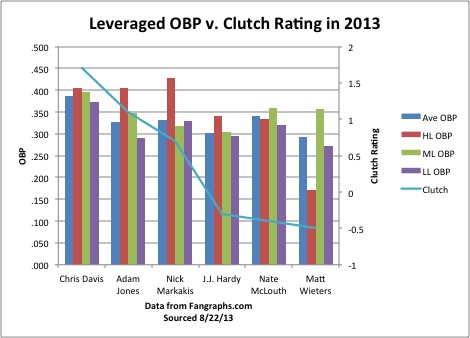
Now let’s take a look at each players OBP in different leverage situations to see if there is anything substantial.  I used OBP as a comparison, to measure the ability to keep the inning alive as critical to increasing your opportunity to score runs.  It is also a clean stat that is taken directly from the field and not manipulated in any way, unlike win probability, runs created, etc.

OBP Clutch Graph

From the chart, it can be seen that Nick Markakis is the most clutch batter on the team in getting on base in high pressure situations this year.  He also has nerves of steel as his OBP rises almost 100 points from his average when he is in a high leverage situation.  Matt Wieters appears to be deserving of his low clutch rating due to his drastically low OBP in high leverage situations.  However, the same can’t be said for J.J. Hardy or Nate McLouth.  Both are roughly the same or above their 2013 OBP average in high leverage situations, making them fairly clutch relative to themselves in low-pressure situations.  Five of six regular Orioles perform better when the pressure is on them to succeed.  This causes me to believe that the clutch rating stat has to be taken with a grain of salt when looking for it to translate onto the field.

With this in mind, I’ll look into the team’s clutch pitching numbers with my next post to see how the 2013 team is comparing to last year’s.

Taking a Look at Mark Reynolds

Posted in Offense with tags , , , , on August 14, 2013 by oriolesprovingground

Last week, the Cleveland Indians designated Mark Reynolds for assignment.  Orioles fans should be familiar with Reynolds, as he spent all of 2011 and 2012 with Baltimore, coming over in a trade from the Arizona Diamondbacks.  During his two years in Baltimore, he accumulated -0.2 fWAR.  Most of that was a function of the fact that he plays terrible defense (at any position) and doesn’t run the bases effectively.  Despite the negative WAR, he was an above average hitter during his time in Baltimore, with a cumulative line of .221/.328/.458 (AVG/OBP/SLG), and a 112 OPS+ (meaning he was 12% better than the average hitter, who has an OPS+ of 100).

If you’ve read this blog at all, you should know that the Orioles have had trouble getting production out of the DH spot in 2013, since we’ve talked about it a couple of times.  If you haven’t been reading this blog, you can find those discussions here and here.  Baltimore’s designated hitters have combined for a .230/.275/.385 triple slash line, and a .288 wOBA, good for 14th in the American League.  With that in mind, it would seem like the recently available Reynolds could provide an upgrade for Baltimore’s DH spot.

Through 99 games with the Indians this year, Reynolds has a triple slash line of .215/.307/.373, and a wOBA of .303.  While Reynolds’ production this year would have been an upgrade over what the Orioles have gotten out of DH, it wouldn’t be much of one.  Additionally, we don’t care about the past, we care about the future.  Would Mark Reynolds provide more offense for the Orioles in their final 44 games than anything they already have available?

Overall, Reynolds’ season isn’t too far off from his career numbers.  His AVG, OBP, BB%, K%, and BABIP are all at or around his career averages.  The biggest difference in 2013 has been his lack of power.  His current ISO of .158 is easily the lowest of his career, in addition to it being under .200 for the first time.

Reynolds has experienced two different seasons in 2013.  There is the month of April, and then there is everything else.  Take a look.
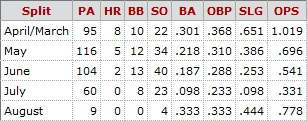
Provided by Baseball-Reference.com Generated 8/13/2013.

Provided by Baseball-Reference.com
Generated 8/13/2013.

That’s not trending downward, that’s falling off the cliff.  The Indians stuck with Reynolds as long as they could, but they severely cut his playing time in July and eventually just took him off the roster completely.

Prior to their recent trip through the National League West, the Orioles have been using a mix of mostly Henry Urrutia, Danny Valencia, and Steve Pearce at the DH position.  They have been deployed in a platoon, with the left-handed Urrutia getting most of the at-bats.  There are small sample size issues with each player’s performance.  Pearce leads all three in PA’s, with just 102 on the season.  Despite that, let’s look at how they’ve done this year.

Henry Urrutia (47 PA’s)                 .298/.298/.340
Danny Valencia (78 PA’s)              .216/.256/.500
Steve Pearce (102 PA’s)                 .261/.333/.402

Pearce owns the best triple slash line of the group and has Reynolds beat in every category.  However, the majority of Pearce’s PA’s have come against left-handed pitching.  He’s completely ineffective against right-handers and because of that, he can’t be counted on as an everyday DH.  Urrutia, who has faced right handed pitchers almost exclusively since being called up, has an impressive average, but only has one extra base hit (a triple), and has not walked once.  Valencia has hit for some power, but not much else.  His average may be held down by his .216 BABIP (despite a line drive percentage around the league average), but his slugging percentage has been buoyed by his lofty 18.5% HR/FB rate, approximately 10% higher than his career level.

So where does that leave us?  It leaves us with 4 terrible options at DH.  While Dan Szymborski’s Zips projection system at Fangraphs sees Reynolds as a slightly above average hitter the remainder of the season, the depths of his terribleness in June and July make me think Zips is a little too optimistic.  However, Baltimore fans know that Reynolds can occasionally go on one hell of a hot streak, which could make him very valuable to the Orioles down the stretch.  If Reynolds is able to pass through waivers without getting claimed (VERY likely), the Orioles could roll the dice on him for basically nothing more than the cost of a roster spot.  Given the limitations of Baltimore’s current options, it’s probably worth a shot.